keep focus: turn off distractions!
How many times have you looked at your mobile phone, mailbox and social media today? When was the last time? What did you interrupt for it? Recognisable? Then you are the possible victim of the Zeigarnik effect. Quickly to the doctor or...?
Unconscious compulsive behavior?
What makes us - in an almost unconsciously compulsive way - check our electronic mailboxes every time? Dozens of times a day, you would click on your mailbox, and that's not counting your mobile phone.
Gotta catch 'em all!
Russian psychologist Bluma Zeigarnik discovered that people in principle remember tasks better when they are not finished, or are still open. This is known as the Zeigarnik effect, or - freely translated - the law of the unfinished task.
We then apparently get a biologically ambitious feeling that always wants to go back to those unfinished to-do's, so that we can let go of them and stop haunting them. After all, you like to have your act together!
This is often used conveniently: wanting to complete a collection responds to this commercially. Think of the Panini stickers of the past and all kinds of collectable toys when you buy them, even today, from the easy-to-play target group of children. The Pokémon Go hype had even more impact - even on adults - & the social media apps are still there today: they always tell you how many new posts are waiting for you -even the standard -annoying- messages you get about them - and draw you to their application, they create an addictive effect so that you stay on their platforms as long as possible, more susceptible to advertising and analysis of your personality.

Your mail can also be addictive, but - according to my wife Carine - that may also be due to you - or did she mean my - curiosity.
Curiosity killed the cat but satisfaction brought it back...
Something starts watching - process - the trigger -: curiosity, general nervousness, wanting to answer everyone quickly -social confirmation, wanting to express yourself-, wanting to be up to date, a ping on your screen... Then it makes you do something - action -, like go to your inbox. And that while - if you think about it - you know that it is not necessarily healthy - you know it takes time and attention - but you still persevere. After all, you will be physically rewarded for it afterwards - reward - with a shot of dopamine - satisfaction - .
From a brain point of view, this reward system is located in the nucleus accumbens and amydala, where you also have the urge to eat, drink and nose... uh... reproduction, essential for the survival of the species “t o live long and prosper”, Mr. Spock would say.
In that regard, checking your mail excessively is therefore a primary unconscious urge to survive and even a formed habit. This is beautifully described, among other things, in the book The Power of Habit by Charles Duhigg .
And the longer that habit is activated, the more you practice it. For this, see Nir Eyal's book Hooked: How to build habit-forming products. Hence the great need to...
rehab!
How would you feel if you weren't allowed to check your mail today? What would be the consequences? Think about it for a moment and feel with yourself instead of responding too quickly ?
But at the same time, imagine what it would be like if you knew beforehand that you wouldn't receive messages for a whole day, week, or weekend. Neither mail, nor social media, nor text or phone?
- so you will initially become aware of this unproductive behavior,
- accept it as a bio-logical response in itself,
- and decides to want to do things differently from there and go for a new habit.
How to get back to the wheel?
How do we now make useful use of Madam Zeigarnik and Spock's rational way of using our inbox and incentives in a smart way?
- of course, you turn off all email notifications and notifications from other apps so that the trigger is no longer external: read tidy or tidy: distraction = lead & stay out of your mailbox: start in your agenda & stay out of your mailbox: some smart shortcuts!
- then we first make sure that our mailbox is empty, do you also want an empty inbox: grab = decide!
- put a counter on your inbox folder so that it shows the number of mails still to be processed in the folder from now on. This gives you an estimate of your workload at a glance: right-click on the folder in question. At the bottom, choose properties and press Show total items.
By the way, as an aside: long live mail! The easy thing about your mailbox is that it is the quintessential place for work. Imagine that your work could come from all sides, you also have to keep an eye on them all, resulting in a loss of energy. So... long live a controlled inbox !
So now another healthy drive/rational trigger to empty your mailbox: time managers recommend checking your mailbox once in the before and once in the afternoon. That doesn't work for me. Others recommend leaving your Outlook turned off. I don't find it useful either. So find a method that suits you personally. For example, what works for me: every time I finish something, I reward myself with processing my mail. The inbox counter also inspires me to empty the mailbox at night, the task force of the Zeigarnik effect. This means, on the one hand, that I was able to inventory everything that came my way that day and, on the other hand, that I had x number of shots of endorphin/dopamine .

And action!
- What about your survival mechanism? Are you suffering from or managing your mailbox?
- What new habit are you going to get started with?
As a manager?
- To what extent do you control all incoming channels of work? Or do they dominate you ?
- What constructive action are you going to take towards your own inflow management and that of your team?
- What would be the effect if this were fully streamlined in the team, do you think?
- If you have a nice anecdote or question about this, send me a message!
- With the FORWARD button below, you can share this blog with a peer.
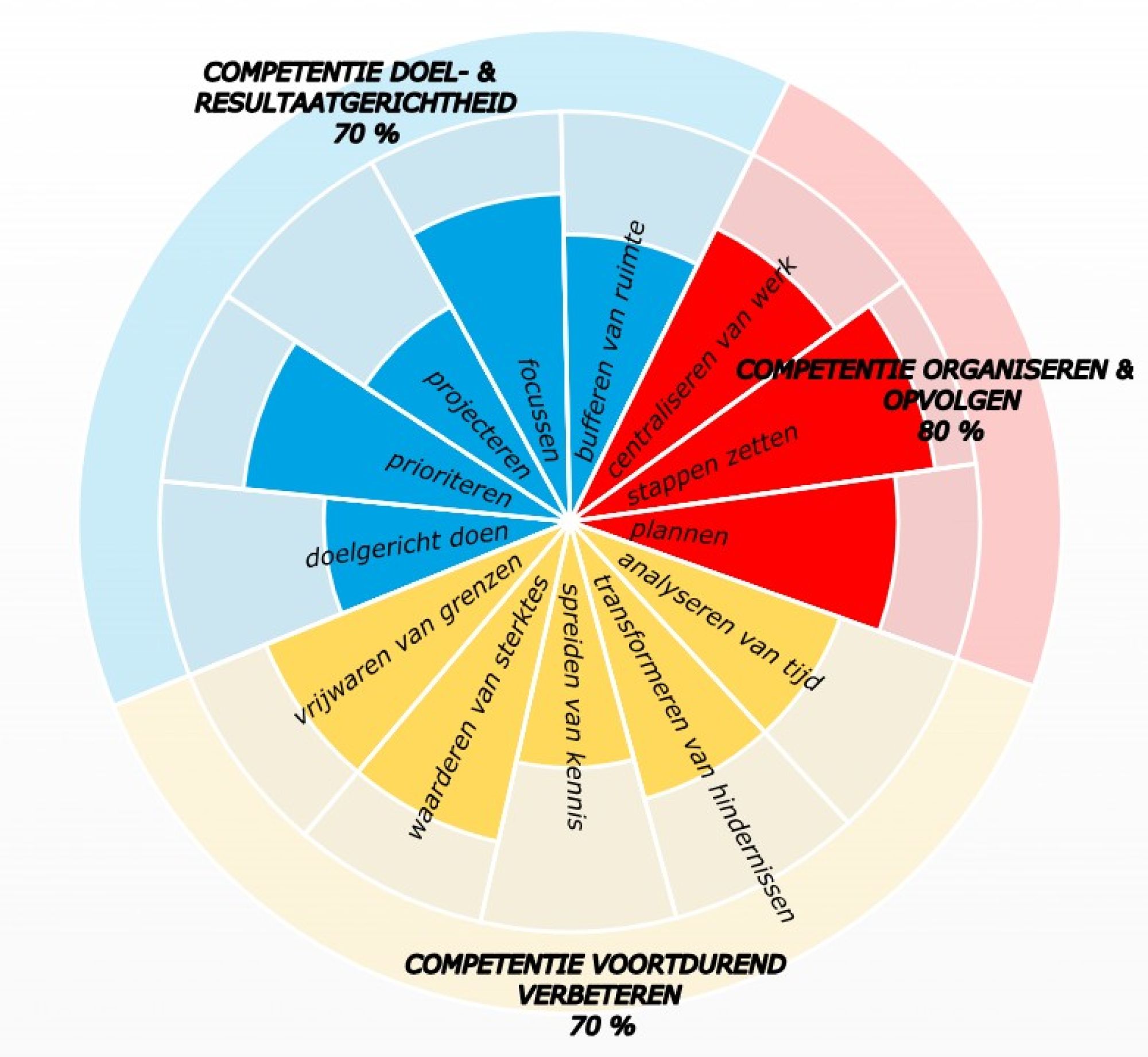
- If you want to score yourself on time competencies, fill out your self-scan!
- If you want to get to know the whole method, read the book GOD - Goal Oriented Doing.
One life, live it & love it!
Your time profile + immediate advice?